
How to Get a Driver’s License in Dubai
December 16, 2025
Marwa Safaris: Discover the Authentic Kenya with Expert Guides and Safe Travel Experiences
December 28, 2025
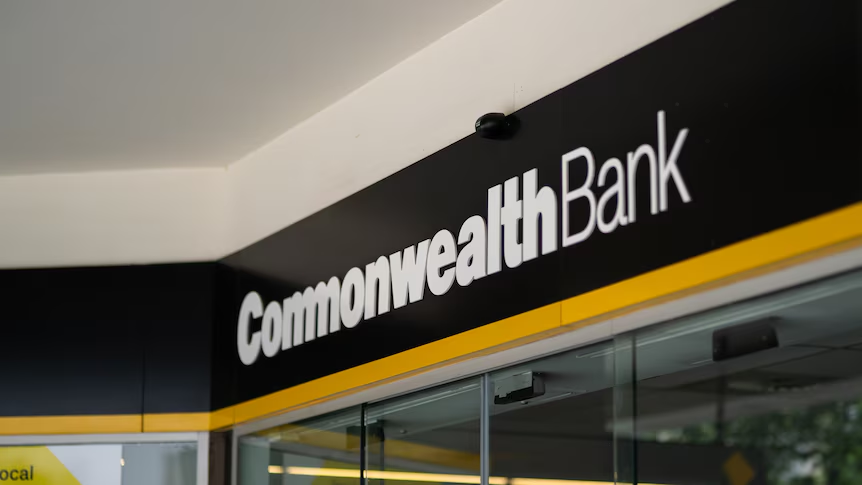
Commonwealth Bank (CommBank) has announced that it will issue refunds to customers who were unfairly charged excessive bank fees. This decision comes after the Australian Securities and Investments Commission (ASIC) discovered that the bank had wrongfully charged low-income earners on Centrelink payments a total of $270 million in fees. The refunds will total $68 million, focusing on “relevant” customers who were disproportionately affected by these charges. This marks a reversal in CommBank’s previous stance, as it had initially resisted refunding the fees despite the findings of ASIC’s review.
The Background of the Issue
In July 2025, ASIC released its findings after reviewing the practices of 21 major banks. The investigation revealed that low-income customers, particularly those receiving Centrelink benefits, were being charged unreasonably high fees, including account-keeping, dishonour, and overdraw charges. These fees were seen as particularly damaging for individuals already living on tight budgets.
CommBank, which had been one of the banks identified in the review, initially rejected the need to refund the $270 million in fees. However, following mounting public pressure and the release of ASIC’s Better and Beyond Banking Report, the bank reconsidered its decision. The report, which followed an earlier inquiry into the treatment of First Nations customers, had led to other banks, including ANZ, Westpac, and Bendigo Bank, agreeing to refund a combined total of $60 million.
The Refund Announcement
In its statement, CommBank confirmed it would refund a total of $68 million to low-income customers who were charged excessive fees, fulfilling its commitment to addressing the issue raised by ASIC. The bank emphasized that the refunds would be offered to customers who had incurred unusually high fees and that it would continue to work to rectify the situation.
This move brings CommBank’s total goodwill payments to $93 million, which includes $25 million previously refunded to account holders identified in an earlier report that focused on high fees imposed on First Nations customers.
Criticism and Response
The decision to refund only $68 million has drawn mixed reactions. Alan Gray, a financial counsellor representing First Nations clients in Western Australia’s Kimberley region, expressed his disbelief at the bank’s sudden shift. For months, CommBank had publicly claimed that it had done nothing wrong and had no obligation to refund any of the $270 million in charges. However, Gray criticized the decision, pointing out the “logical and ethical contradiction” in the bank’s approach. He argued that the bank should refund the entire amount and not just a fraction of it.
“It’s just not good enough,” Gray said, calling for the bank to “do the right thing.” He also urged affected customers to seek assistance from financial counsellors for advice on how to handle the situation.
ASIC’s Stance on the Refunds
ASIC welcomed CommBank’s decision to refund the $68 million but expressed disappointment that many customers who were charged excessive fees would not receive any compensation. ASIC Commissioner Alan Kirkland emphasized that the excessive fees had a significant impact on low-income earners, making it harder for them to afford essentials like food and utility bills. He reiterated that it was always the expectation that banks would resolve these issues without the need for litigation or further regulatory action.
“We expected banks to make it right,” Kirkland said. He also urged affected customers to contact their bank directly to inquire about their eligibility for a refund.
What’s Next for CommBank Customers
CommBank has confirmed that it will begin issuing refunds in February 2026. The bank plans to contact eligible customers directly, but Kirkland encourages people to be proactive and reach out to their bank if they believe they are entitled to a refund. Financial counsellors are also available to assist customers in navigating the refund process and ensuring they receive the compensation they deserve.
Alan Gray also advised that individuals contact local financial counselling agencies to help them through the process, expressing skepticism about whether CommBank would fully follow through with its commitments.